
The Notes App Dictionary
Forging memory through words

I have built a list in my Notes app that is verging on Webster’s dictionary level style entries. A project I started a few months ago, it’s made up mostly of Spanish words. Words I have happened upon through various avenues. Many that I’d never come across before, or perhaps, forgotten, or those which surprised me when first reading them. I’m trying to reclaim a language and also trying to reclaim curiosity.
We encourage curiosity, play and inquisitiveness in children but we don’t often create the spaces or conditions that might afford adults the same pleasure.
Creation and curiosity are two sides of the same coin. As writers, we should always be striving to hold both in tandem. For those who draw upon the self in our art, being patient and permitting (re)learning opens up further possibilities of surfacing that curiosity. For me, (re)learning language means my world building can be all the richer.
Lately, I’m forcing myself to battle through Spanish language texts to further amass words and their meanings. When visiting Spain, I find myself in museums slowly reading the placards and curatorial notes with studied interest. In the quiet hush of a gallery, I find connections to myself, my family, a past but also a present. I want to live in these moments for as long as possible. I want to be surrounded by words that are part of my greater history. I want to hold space for both so as to see what might come from it.
I was in Valencia in October visiting IVAM – Institut Valencià d’Art Modern. While walking through the sculpture wing, I ran into my grandfather. By that I mean, I ran into a part of him I had never had the language for. Sad, no? Because in that moment, I realized there was an aspect of him, I only ever knew how to explain in English. My grandfather was a welder by trade, but an artisan by heart. Forging art from iron and ore in his ‘casita’ which housed all his tools, the sparks of his welding gun which both intrigued me and scared me as a child, his tubs of black paint and nuts and bolts he would melt down to magic into something unexpected – an eye of a flamingo, the claw of a lizard.
On this particular day, I was struck by a statue created by Catalan born Julio González. The statue features a dancing woman and flower which very much shares synergy with modernist artists of that time (Picasso, Miró, etc.). But what was most alluring was the placard.
In English, Spanish, and Catalan, it stated the artist, title, and material. Hierro forjado y soldado. Welded wrought iron. I had never known how to say those words (hierro: iron; forjado: wrought/forging; soldado: soldered/welded). These are words I saw my grandfather enact numerous times but I never asked him how to say them in Spanish. I just saw him do it.
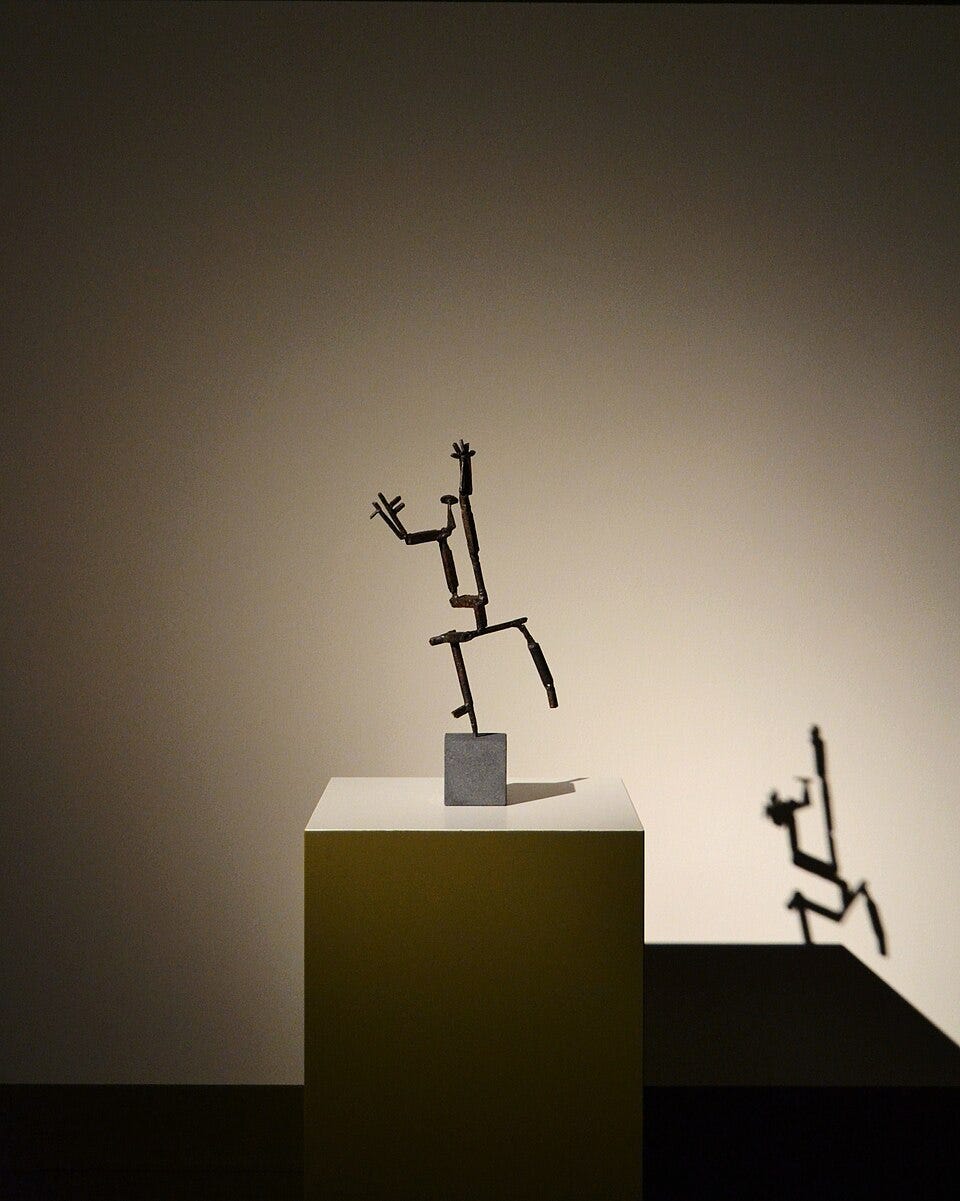

How sad to not know how to speak of him as he was – to only remember him in a language that wasn’t his.
One of my favourite memories of my grandfather, was a ride he took me on in his faithful pickup truck one summer in my early twenties. My grandfather had many grandchildren and it was rare to have one on one time, especially free from my own siblings. But that day he invited me to go run an errand with him. He was a welder for a company in California’s capital but he would spend his weekends working on his own crafted beauty. Anything from garden decorations like peacocks and ladybugs, to refitting barrels with hinges to serve as beer buckets for family parties. But some of the most memorable and long-lasting legacies of his are the iron gates he created for numerous family members and friends in the small town my parents were raised.
On this day in which he drove me around town, he pointed out all the iron gates which he had forged (había forjado) from iron (hierro). He decorated these gates with filigree and horseshoes, spindles and arches. His work still guards the house my mother and her siblings were raised in. Even now, I can picture opening the door that sits between the gate’s main entrance, I can hear its creaky hinge opening onto the redbrick pathway that leads to main door of the house.
Whenever I am in a museum, or at a university graduation show, I often think of how my grandfather was an unnamed artist. I wonder what a gallery space of all his creations would look like sitting atop well-lit podiums. I ponder how a stranger might take in his curiosity, his ability to take a living, breathing thing and forge it in iron and make the metal come alive again.
For me, I’m trying to amass language to make something hidden come alive again. My Notes app is growing longer, turning into an almost found poem: piedra (stone), agujero (hole), madreselva (honeysuckle), tinieblas (darkness). At least I am learning I can break words down. That I actually have more language than I realized/remembered.
Madreselva forged from ‘mother’ and ‘jungle’. Tinieblas with its hidden fog. I am finding things everywhere I look.
I find poetry less daunting to read in Spanish than prose. I can be kinder to myself due to its form, sparseness, richness in imagery. My fluency is embarrassingly not at the level I would like, but it exists. This I mustn’t forget, and within the context of other words on the line level, I can forge ahead with a poem’s meaning.
“En el sueño ella no es la suave forma ella no es la flor del cerezo en su balanceo hacia el pavimento ella no es nido de garzas sobre el agua”
Conjuros y cantos, Sara Torres (2025)
I spent this summer translating work by Roshni Gallagher as part of Our Many Voices with Scottish Makar Peter Mackay. One of the poems I translated was Gallagher’s ‘Bird Cherry’ from English into Spanish and spent many weeks thinking about ‘cereza’ and ‘flor’, but also, she translated some of my Spanish language poems into English. There is one I wrote about a ‘garza’ I happened upon during a sweaty June run along the Union Canal. How I longed to see the world from the heron’s view high above the landscape.
Reading Sara Torres’ collection inspired by the occult, witchcraft, and sisterhood was a sensuous experience. Her poetry makes language come alive! Spending time with her poems in the original Spanish afforded me curiosity, intrigue, and gifted me numerous new words. I want to push myself to read more verse in Spanish (luckily I have a growing collection from bookshops across Spain and México).
In Spanish, I tend to draw upon the natural world quite a bit. The babbling of a stream (arroyo), the fluidness of water (fluida), the petal of a columbine in my garden (pétalo). I try to harness the nature in order to articulate myself in this mother tongue.
Una Garza parada
Corrí cerca de arroyo tranquilo
me pare cuando vi una garza
alta y elegante parada allá
Tomé una foto, muy borrosa
pero quería recordarla—
una imagen de poder y fuerza
En otra vida, quisiera
ser un pájaro parado
en un arroyo cristalino
En otra vida, quisiera
volar cerca del sol
alto y libre: definición de alegría
Como la garza encima de todo
como el arroyo sinuoso y fluido
The Notes app is growing bigger and bigger, the more language I unearth. My grandfather recreated life from iron, and I follow him through lyric and verse. Don’t you know that poetry is also iron?